
What we do..
Our laboratory works at the intersection of experimental immunology, human immunology, metabolism, and computational biology. We use systems-level measurements to identify unexpected structure within complex immune states and then reduce that complexity to specific, experimentally testable mechanisms. When existing experimental or computational approaches are not sufficient for the biological question, we develop new ones.- Immune Aging We aim to understand how the human immune system changes with age, why specific immune-cell states emerge, and how aged tissues help generate those states.
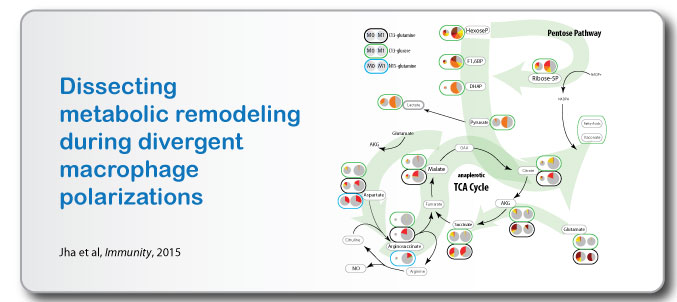
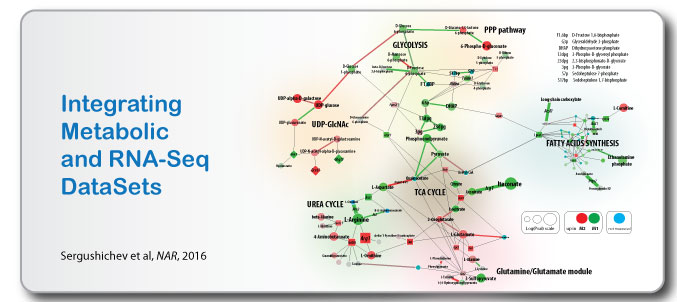
- Immunometabolism One major example of this approach is our dissection of the metabolic rewiring of M1- and M2-polarized macrophages (Jha et al, 2015) that highlighted metabolic breakpoints of TCA cycle and the redirection of the metabolic flux to itaconate in M1 macrophages, as well as glutamine and UDP-GlcNAc dependence of M2 polarized macrophages.
(1)Our work identified clonally expanded GZMK+ CD8 T cells (Mogilenko et al, 2021) as a conserved feature of immune aging and inflammaging and showed that their development is strongly influenced by the aged tissue environment.
(2) We subsequently built large, deeply phenotyped human cohorts to define reproducible trajectories of healthy immune aging at single-cell resolution. Our single-cell atlas of healthy human blood (Terekhova, Swain, Bohacova et al, 2023) revealed, among other changes, a coordinated shift toward type-2 immune potential with age and identified previously unrecognized age-associated gains and losses of specific memory T-cell populations.
(3) We have also developed practical ways to measure fundamental processes of immune aging. In particular, we showed that high surface CD38 identifies human recent thymic emigrants (Bohacova, Terekhova et al, 2024) , providing a direct cytometric measure of declining thymic output.
(4) More broadly, we have tried to help establish conceptual and methodological standards for the field. Our recent review, Human immune aging (Terekhova, Bohacova, Artyomov, 2025) , synthesizes current understanding of immune aging across circulating and tissue immune compartments, integrates evidence from classical cytometry and modern single-cell approaches, and discusses why human aging studies often disagree and what is required to distinguish robust biological trajectories from cohort- or methodology-specific effects.

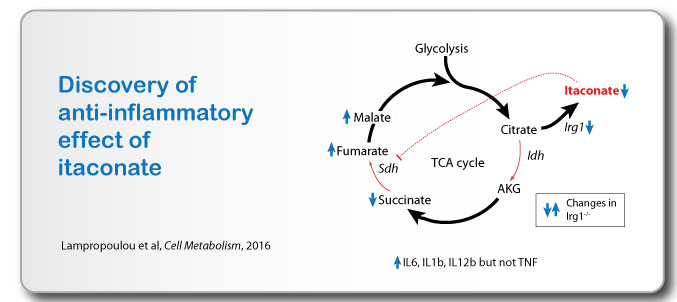
This systematic work led us to discovery of anti-inflammatory action of itaconate (Lampropoulou et al, 2016) where using mice lacking endogenous itaconate (Irg1-/-) we show that itaconate inhibits Sdh and inhibits production of pro-inflammatory cytokines Il1b, Il6 and Il12b.
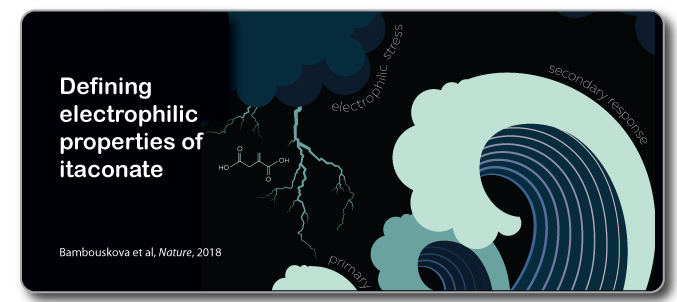
In our most recent work we show that itaconate is also a natural electrophile (Bambouskova et al, 2018) and can trigger electrophilic stress response when produced in activating macrophages: we show that induces both Nrf2 and Atf3 driven responses. Importantly, this property of itaconate can be chemically enhanced by using certain itaconate derivatives to treat autoimmune diseases associated with Ikbz disfunction, such as psoriasis.